One PLAN, seven steps, five tiers, six numbers, with scripts, templates, checklists and an Event scorecard you can copy.
How to use this playbook
Who this is for
Founders of business-to-business tech startups who go to trade shows, conferences and industry events to win customers/investors. With or without a booth, alone or with a small team.
When to use something else
You don't yet know who your customer is: this assumes you do. Or the event's only goal is brand, hiring, increasing awareness or gaining general knowledge about the competitors.
Part One, the Method (sections 1 to 2)
The whole idea in a few pages: the picture, the words, the rules and the numbers. It doesn't change from event to event.
Part Two, the Playbook (sections 3 to 17)
How to do each part of the picture: scripts, templates, checklists, the Event scorecard and real examples. Use what fits your event.
The visuals
The playbook overview comes first (section 2). Every later visual zooms into one card of it. The strip of steps at the top of each visual is the overview's top band, with the part you are reading highlighted.
Read Part One once. Take the Playbook to the event.Money is shown in Swiss francs (CHF); any currency works the same way. Templates and scripts sit in shaded boxes, so you can tell them apart from the playbook text at a glance.
Part One · The Method
The whole idea: the picture, the words, the rules and the numbers. It doesn't change from event to event.
1. The idea in one sentence
An event is worth the meetings it books you: before, during and after.
Badge scans, booth traffic and great conversations feel like progress. Only booked meetings are.
The Method in one PLAN and seven steps
PLAN
Shapes every step
Strategy, Setup, Roles and Get noticed.
1
Book ahead
Before the event, book meetings to hold at the event, each with a fixed time and place.
2
Book at the event, using Booking Moves
Every conversation aims for a next meeting after the event, in the calendar before you part. The Phone Pass is one way to book it.
3
Five tiers
Every person you meet goes into one tier: Booked, Not now, Wrong timing, Referral or Let go.
4
Follow up
After the event, book those who didn't book at the event.
5
Hold the meetings
The meetings booked for after the event take place.
6
Event scorecard
Your numbers, on one page per event.
7
Compare
Each number against the same number at your other events: short term booked meetings, long term return on investment.
Each part depends on the others: use parts of it and you get parts of the result.
2. Walk Out Booked overview
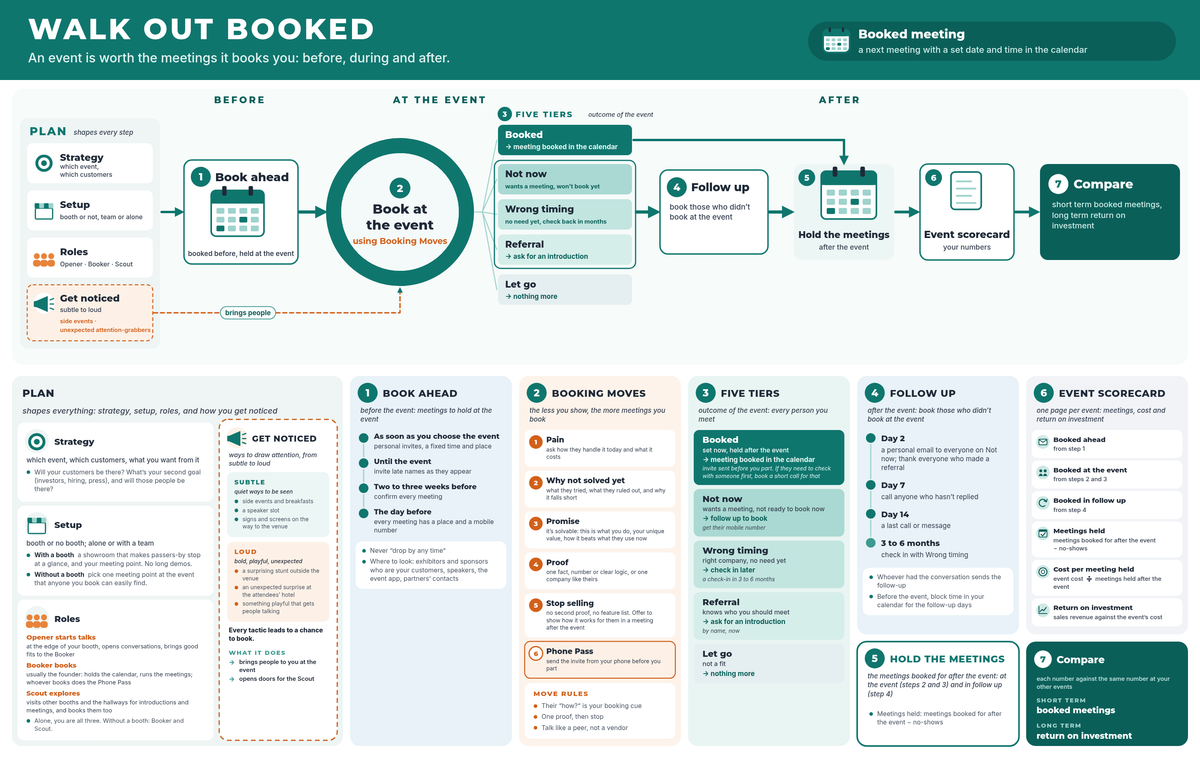
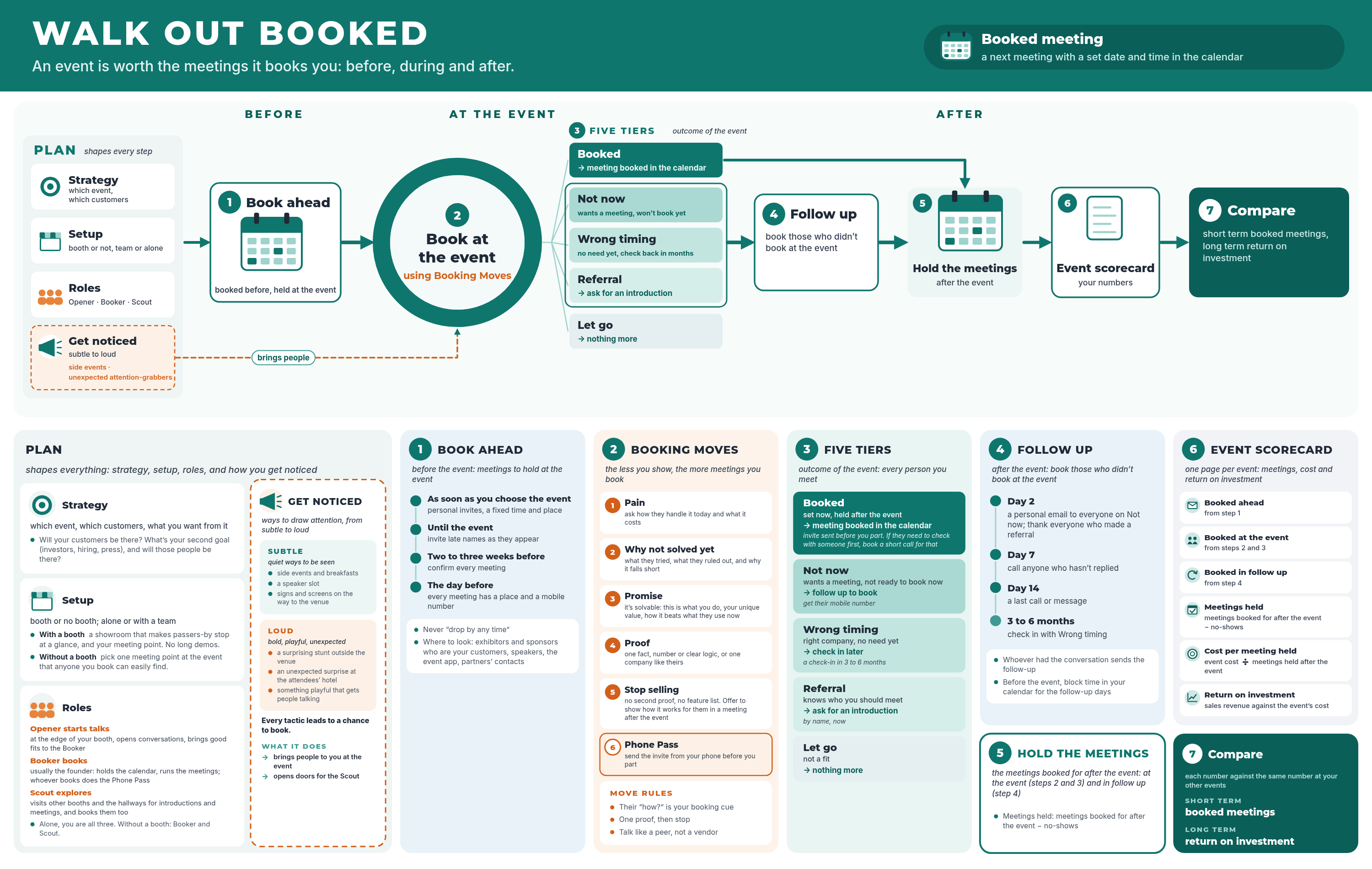
The whole method in one picture: PLAN, then the seven steps from before the event to after it.
The top band is the flow, from left to right: BEFORE, AT THE EVENT, AFTER. PLAN sits on the left because it shapes every step. Get noticed is part of PLAN, and its dashed line shows what it does: it brings people to step 2.
Step 3 is the outcome of the event. Booked goes straight to step 5, Hold the meetings. Not now, Wrong timing and Referral go to step 4, Follow up. Let go needs nothing more.
The bottom row has one card per part, with the detail. Sections 3 to 12 zoom into each card in the same order.
The pill at the top right says what a Booked meeting is: a next meeting with a set date and time in the calendar.
2.1 What counts as a Booked meeting
A Booked meeting is a next meeting with a set date and time in the calendar.
If they need to check with someone first, book a short call for that. For "I need to check with my boss", a 15-minute prep call with its own date and invite counts as Booked once it is in the calendar.
Anything less is not Booked. "I'll send you something", a card, a scan or "let's stay in touch" is not a meeting. If they want a meeting but won't book yet, they go into the tier Not now.
Meetings you book before the event are counted on their own, as Booked ahead: they are held at the event. A meeting booked at the event is set at the event and held after it.
You can't walk out booked without a date.
2.2 The numbers
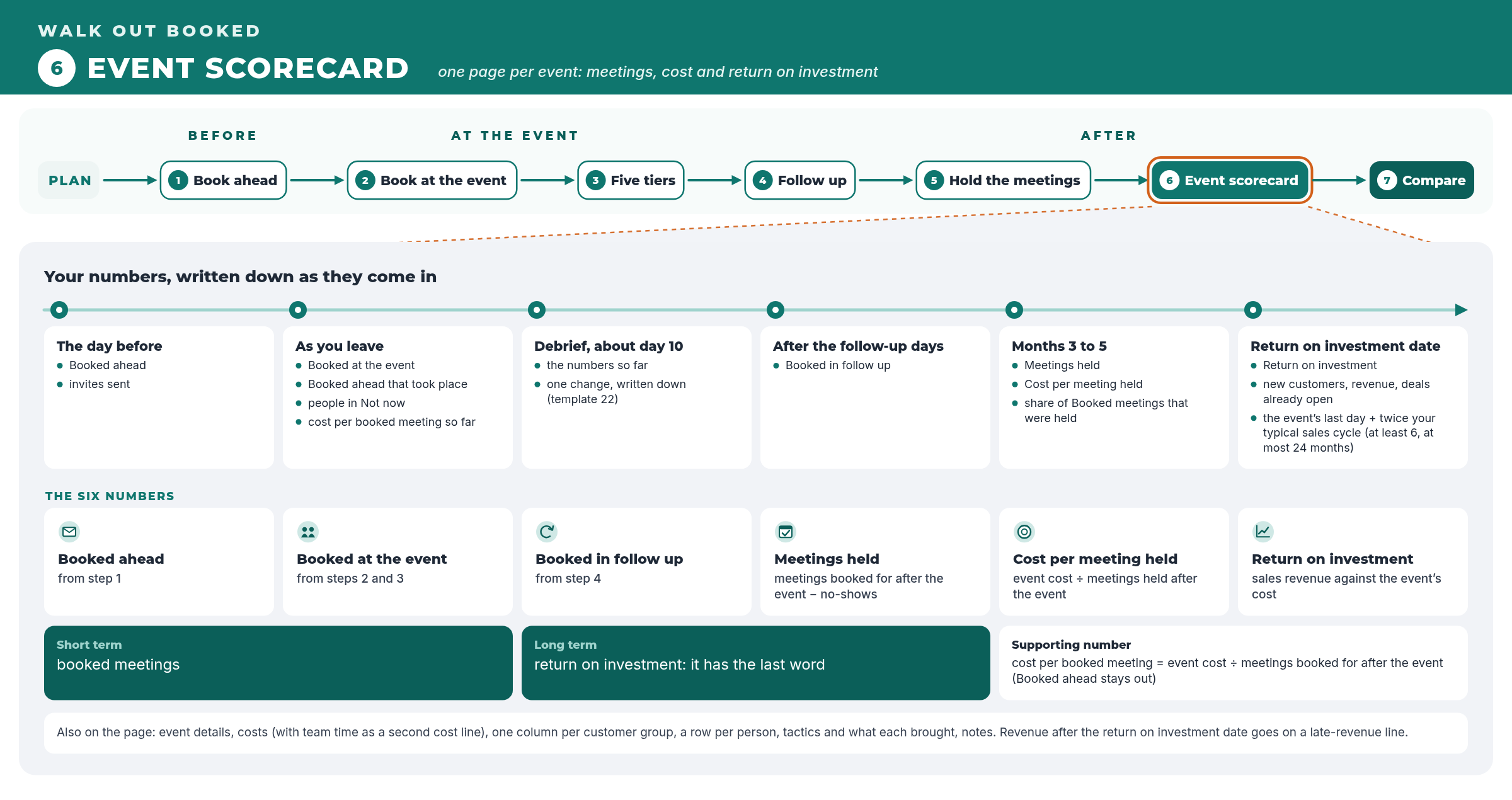
The Event scorecard holds six numbers. Each one has its own line; none is added to another.
Number
What it is
When you write it down
Booked ahead
meetings booked before the event, held at the event (from step 1); also note how many took place
the day before the event, and how many actually took place as you leave the event
Booked at the event
meetings booked at the event for after it, however you met the person and however you booked (from steps 2 and 3). One count, not split by method
as you leave the event
Booked in follow up
meetings booked after the event with people you met there (from step 4)
after the follow-up days
Meetings held
meetings booked for after the event − no-shows
months 3 to 5
Cost per meeting held
event cost ÷ meetings held after the event
with Meetings held
Return on investment
sales revenue against the event's cost: revenue signed before the return on investment date by the people you met, minus everything the event cost (tickets, booth, travel, hotel, giveaways, helpers). CHF 5,000 − CHF 1,000 = CHF 4,000. Because it is money left over, not a ratio, this guide also calls it the net return
at the return on investment date
Short term, booked meetings. Long term, return on investment. These two lead when you compare events (section 12), and the net return has the last word.
One supporting number: cost per booked meeting. Event cost ÷ meetings booked for after the event, at the event and in follow up. Booked ahead stays out of it. Work it out first as you leave: CHF 1,000 ÷ 100 booked meetings = CHF 10 each. It is an early read on what a meeting costs you, so you can see what you can afford.
Badge scans, booth visitors and likes are never counted.
Part Two · The Playbook
Everything here serves the Method, in the order of the main picture: PLAN, then steps 1 to 7. After them come the checklists, the scripts, your first five events, a worked example and what goes wrong.
3. PLAN · Strategy: which event, which customers, what you want from it
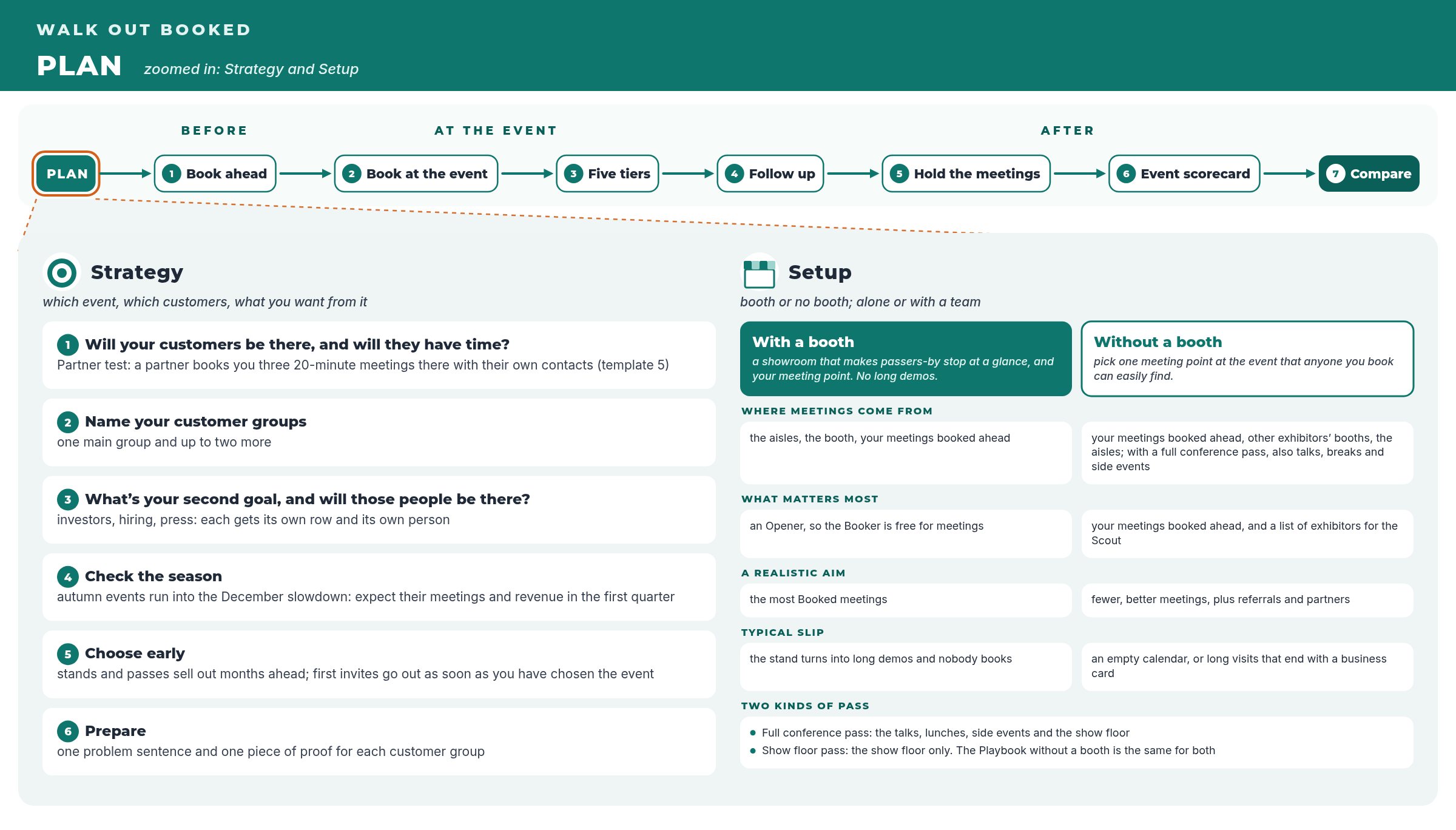
PLAN, zoomed in: Strategy and Setup.
Choose the event weeks to months before. Stands and passes often sell out months ahead, so the choice comes first, and your first invites go out as soon as you have chosen it (section 6): the people you want to meet fill their calendars early.
Will your customers be there, and will they have time?
Try the partner test: ask a partner or a friendly customer to book three 20-minute meetings at the event with their own contacts (template 5). If nobody can, the event may have none of your customers. This works even when you have no data on the event at all.
Name your customer groups.
One main group and up to two more. For example: heads of plant operations at mid-size manufacturers first, then the system integrators who serve them.
What's your second goal, and will those people be there?
Investors, hiring and press each get their own row on the Event scorecard and their own person, or they take over the event. One startup came home with 30 investor meetings and 2 customer meetings, even though they were not raising investment and were focused on customer acquisition, because nobody had decided what the event was for.
Check the season.
Events in autumn run into the December slowdown, so expect their meetings and revenue in the first quarter.
Fill in the top of the Event scorecard before you go:
the event, your setup, who does which role, your customer groups, your typical sales cycle and the return on investment date (section 11).
Prepare one problem sentence and one piece of proof for each customer group.
3.1 PLAN · Setup: booth or no booth; alone or with a team
With a booth means you exhibit: you rent a stand on the show floor, and people come to you. Without a booth means you come with a pass and go to the people. Passes come in two kinds: a full conference pass gets you into the talks, lunches, side events and the show floor; a show floor pass gets you the show floor only. The Playbook without a booth is the same for both. If your pass gets you into the talks and side events, use them too.
With a booth
Without a booth
Where meetings come from
the aisles, the booth, your meetings booked ahead
your meetings booked ahead, other exhibitors' booths, the aisles; with a full conference pass, also talks, breaks and side events
What matters most
an Opener, so the Booker is free for meetings
your meetings booked ahead, and a list of exhibitors for the Scout
A realistic aim
the most Booked meetings
fewer, better meetings, plus referrals and partners
Typical slip
the stand turns into long demos and nobody books
an empty calendar, or long visits that end with a business card
Both setups use the same Booking Moves, the same Phone Pass, the same five tiers and the same Event scorecard.
With a booth
Your stand does two jobs: a showroom that makes passers-by stop at a glance, and your meeting point. No long demos. In one startup about 70% of contacts came from the aisles, not from people walking into the booth. Put the Opener at the edge of the stand, facing the aisle. The booth basics are in section 3.2.
Without a booth
Book more meetings ahead: your calendar is your booth. Pick one meeting point at the event that anyone you book can easily find, such as a café near the hall, and put it in every invite.
Walk the floor with a list: exhibitors who are your customers, and exhibitors who sell to your customers. This works with either pass. Talk to the exhibitor's staff when the booth is quiet, ask "who here should I meet?", and leave every visit with a Booked meeting, a referral or a name.
With a full conference pass, book side meetings at breakfast, lunch and after talks, ask speakers for 10 minutes after their session (template 8), and sit at full tables.
3.2 Booth basics (with a booth)
Checklist · What goes on the stand
One line readable from the aisle that names the problem in your customers' words, next to your company name
A sign at the edge for passers-by: "Book half an hour with the founder after the event", with your booking link. It is for people nobody has time to talk to (section 7.3)
A meeting corner: a high table and two to four chairs, away from the aisle
At most one screen, at the side, showing the one thing that matters for the problem; nothing that blocks the aisle edge
The Booker's phone charged, with the calendar one tap away, for the Phone Pass
Giveaways out of sight, handed over only for a booking or a referral (template 16)
A one-page leave-behind, for people who have booked
Water, chargers, a power strip, comfortable shoes
Checklist · Staffing over several days
With a team: someone at the aisle edge at all times, and two people in the busiest hours: the first hour, lunch, and the end of the day
Shifts of at most two hours at the edge, then a break or a walk of the floor
Lunch in turns, before and after the lunch rush
Booth shifts planned around the Booker's calendar, re-planned each evening
If the stand must be empty for a moment, a sign: "Back at 14:00. Book half an hour after the event here."
The stand staffed until the doors close on the last day; packing starts after that
4. PLAN · Roles: Opener, Booker, Scout
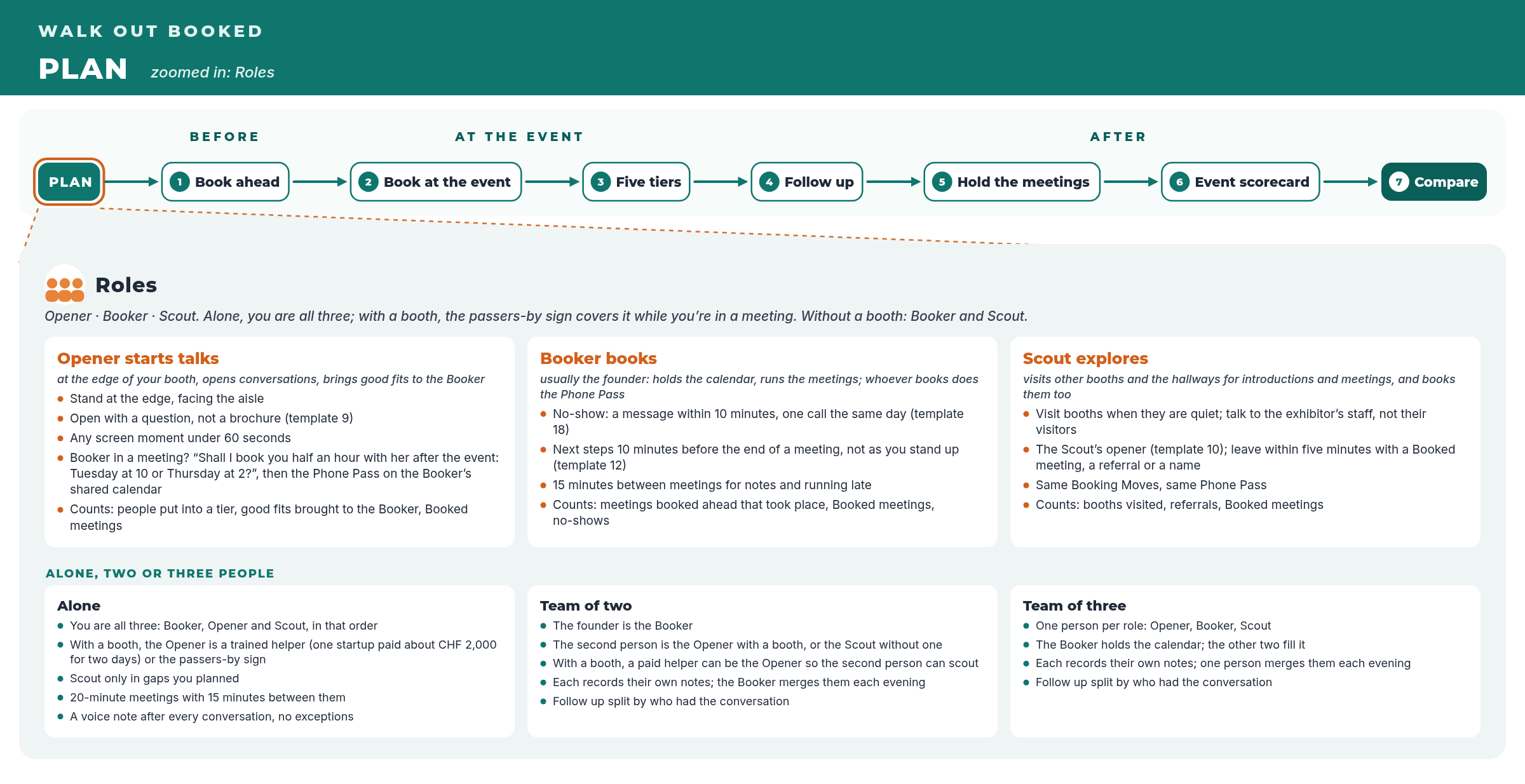
PLAN, zoomed in: the three roles.
Alone, you are all three. Without a booth: Booker and Scout.
4.1 Alone, two or three people
Alone
Team of two
Team of three
Roles
You are all three: Booker, Opener and Scout, in that order. With a booth, the Opener is a trained helper (one startup paid about CHF 2,000 for two days) or the passers-by sign. Scout only in gaps you planned
The founder is the Booker. The second person is the Opener with a booth, or the Scout without one. With a booth, a paid helper can be the Opener so the second person can scout
One person per role: Opener, Booker, Scout
Book ahead
20-minute meetings with 15 minutes between them, near the booth or at a café
The Booker holds the calendar; the second person helps fill it and books time with exhibitors' staff
The Booker holds the calendar; the other two fill it
Notes
A voice note after every conversation, no exceptions
Each records their own; the Booker merges them each evening
Each records their own; one person merges them each evening
Follow up
Block the hours before you go
Split the list by who had the conversation
Split the list by who had the conversation
Opener starts talks (with a booth)
Stand at the edge of the stand, facing the aisle. Open with a question, not a brochure (template 9).
Keep any screen moment under 60 seconds.
Bring good fits to the Booker. If the Booker is in a meeting, the Opener's one line is: "The person you'll want is our founder. Shall I book you half an hour with her after the event: Tuesday at 10 or Thursday at 2?" and the Opener does the Phone Pass on the Booker's shared calendar.
Counts: people put into a tier, good fits brought to the Booker, Booked meetings.
Booker books (usually the founder)
Holds the calendar and runs the meetings. Whoever books does the Phone Pass.
Reminders follow the rule in section 6; no-shows are handled as in section 10 (template 18).
Start the talk about next steps 10 minutes before the end, not as you stand up to leave (template 12).
Keep 15 minutes between meetings for notes and running late.
Counts: meetings booked ahead that took place, Booked meetings, no-shows.
Scout explores (other booths and the hallways)
Visit other booths when they are quiet. Talk to the exhibitor's staff, not to their visitors.
Use the Scout's opener (template 10). Leave within five minutes with a Booked meeting, a referral or a name.
The Scout books too: same Booking Moves, same Phone Pass.
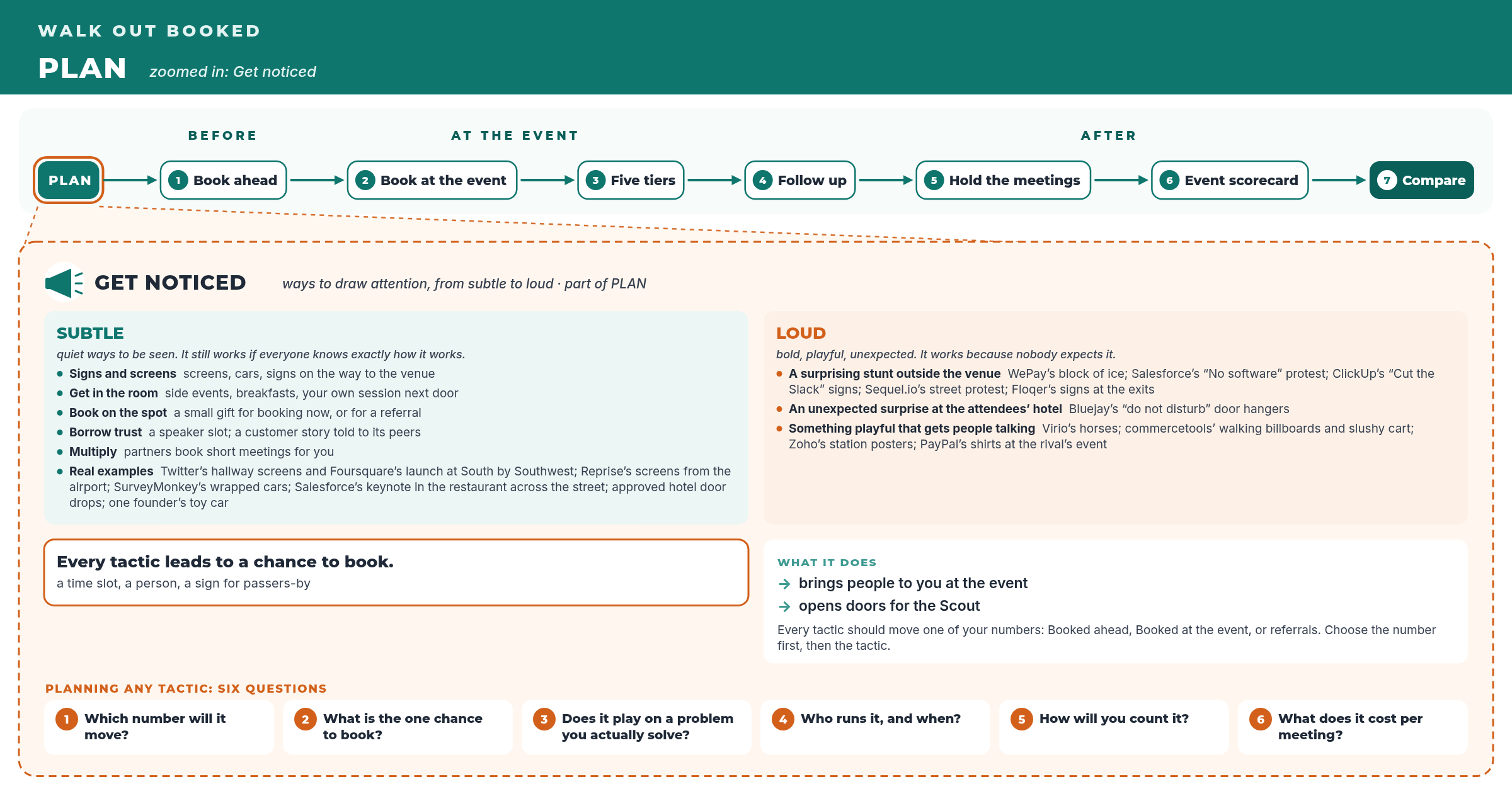
5. PLAN · Get noticed: ways to draw attention, from subtle to loud
PLAN, zoomed in: Get noticed, from subtle to loud.
Get noticed is part of PLAN: kit you bring if it fits your event. What it does: it brings people to you at the event, and it opens doors for the Scout. Every tactic should move one of your numbers: Booked ahead, Booked at the event, or referrals. Choose the number first, then the tactic.
Every tactic leads to a chance to book:a time slot, a person, a sign for passers-by.
5.1 Subtle or loud
A tactic is subtle when it would still work, and you'd be happy, if the person, the organiser and your next customer all knew exactly how it works. Subtle tactics are quiet ways to be seen.
A tactic is loud when it works because nobody expects it: it is bold, playful or unexpected, often outside the official programme, sometimes aimed at a bigger rival.
The same idea can be either. Your own session in the hotel next door is subtle when it is on the event's side-event list, and loud when you run it at the same hour as the rival's keynote.
Hotel doors are a second example. A door drop arranged through the organiser's official service is subtle: every exhibitor can buy one, and it works even though everyone knows how. Bluejay's door hanger is loud: it works because of the surprise, a joke on the hotel's own "do not disturb" sign.
Signs and screens
Get in the room
Book on the spot
Borrow trust
Multiply
screens, cars, signs on the way to the venue
side events, breakfasts, your own session next door
a small gift for booking now, or for a referral
a speaker slot; a customer story told to its peers
partners book short meetings for you
Loud tactics include a playful protest outside a rival's event, cash frozen in a block of ice, hotel door hangers, horses outside the venue, and a crowd wearing your shirt at someone else's show.
One founder's toy car (an idea you can copy).One founder brought about 40 remote-control toy cars, about CHF 8 each, painted in the company's colour, to cover a booth and 20 hosted meetings. They look far more expensive than they are. He used them two ways: to book the next call on the spot, and to turn a poor fit into a referral. The lines he used are in template 16. He handed one over only once the invite existed or the introduction was made. About 5 cars were left at the end.
5.2 Planning any tactic
These questions turn a stunt into meetings:
1
Which number will it move?
Booked ahead, Booked at the event or referrals.
2
What is the one chance to book?
The loud examples that turned into leads all pointed attention to one place: a landing page, a booking link, a person at the exit. Sequel.io put it this way: "the protest was the spectacle; the QR code was the close."
3
Does it play on a problem you actually solve?
WePay's ice was about frozen accounts. Sequel.io protested off-site webinars. Floqer's signs were about pricing.
4
Who runs it, and when?
Exits at lunch and the end of the day see the most people. One team found its horses tired out just before the lunch rush.
5
How will you count it?
Log the cost and the meetings or referrals it brought in the tactics table of the Event scorecard.
6
What does it cost per meeting?
Compare that with your cost per booked meeting.
Ideas to adapt (no documented example found): a breakfast for eight target customers in a hotel next to the venue, booked before the event; your own 20-minute session at a café next to the hall, listed in the event app; a "who here should I meet?" card handed to exhibitors who serve your customers.
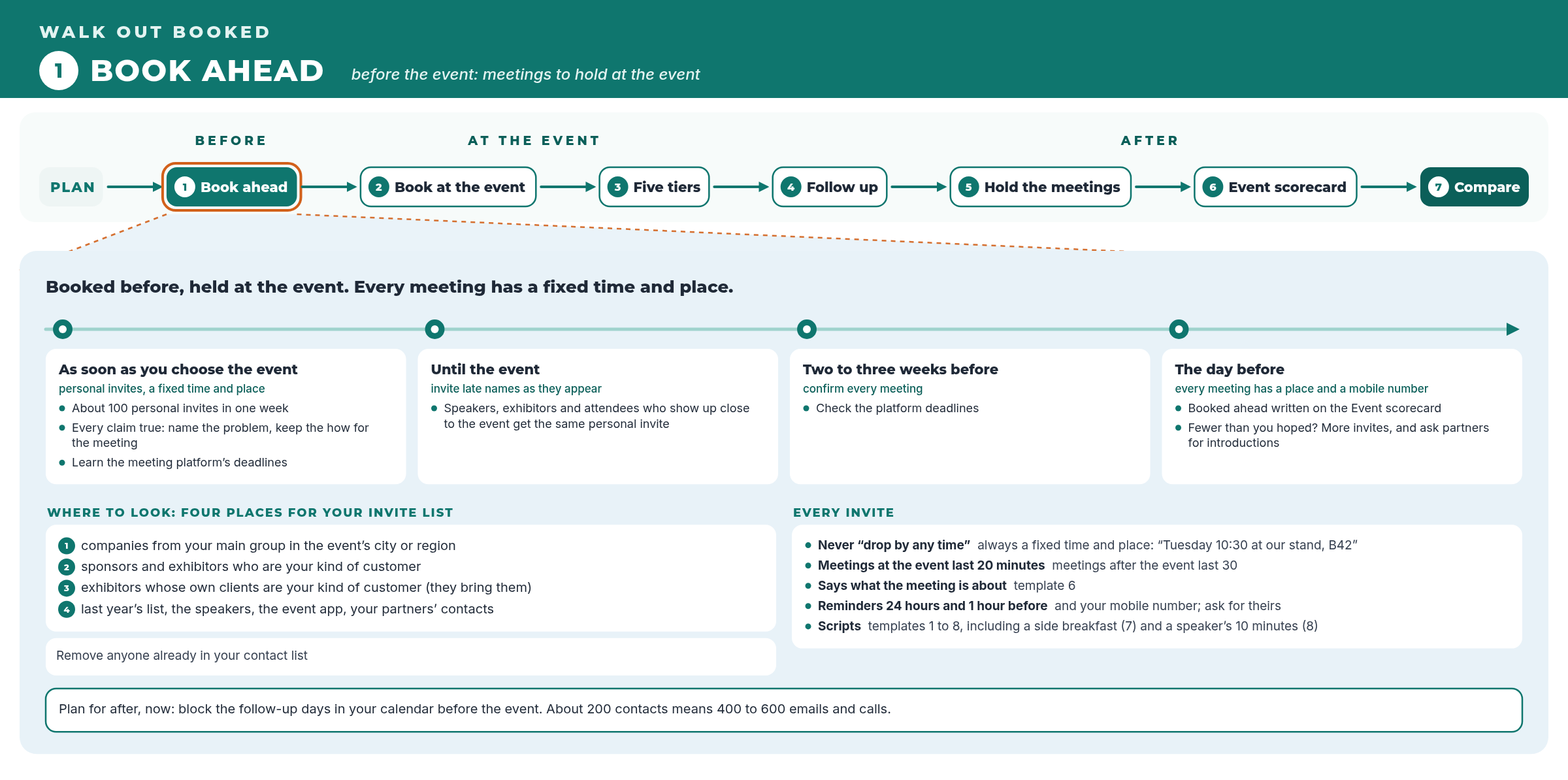
6. Step 1 · Book ahead: meetings to hold at the event
Step 1, zoomed in: Book ahead. Booked before, held at the event.
Booked before, held at the event. Every meeting you book ahead has a fixed time and place, and it is counted on its own line, Booked ahead (section 2.2).
As soon as you choose the event: personal invites, a fixed time and place
Build your invite list from four places:
companies from your main group in the event's city or region;
sponsors and exhibitors who are your kind of customer;
exhibitors whose own clients are your kind of customer (they bring them);
last year's list, the speakers, the event app, your partners' contacts.
Remove anyone already in your contact list.
Send your first invites as soon as you have chosen the event.
Write about 100 personal invites in one week. The earlier they go out, the more calendars are still open. Every claim must be true. Name the problem and keep the how for the meeting.
Always offer a fixed time and place
for example "Tuesday 10:30 at our stand, B42" or "Wednesday 8:00, coffee in the hotel lobby". Never "drop by any time".
Meetings at the event last 20 minutes; meetings after the event last 30.
Use the same lengths in every message and invite.
The reminder rule.
Every invite says what the meeting is about (template 6), has a reminder 24 hours and 1 hour before, and carries your mobile number. Ask for theirs. This rule holds for every meeting in this Playbook, at the event and after it.
Learn the deadlines
of the event's meeting platform, if it has one.
The scripts are in section 14 (templates 1 to 8)
including a side breakfast (template 7) and asking a speaker for 10 minutes (template 8).
Then, until the event
1
Until the event: invite late names as they appear.
Speakers, exhibitors and attendees who show up close to the event get the same personal invite, right up to the event.
2
Two to three weeks before: confirm every meeting,
and check the platform deadlines.
3
The day before: every meeting has a place and a mobile number.
Write your Booked ahead number on the Event scorecard. If you have fewer meetings booked ahead than you hoped, send more invites and ask partners for introductions.
4
Plan for after, now.
Block the follow-up days in your calendar before the event. About 200 contacts means 400 to 600 emails and calls.
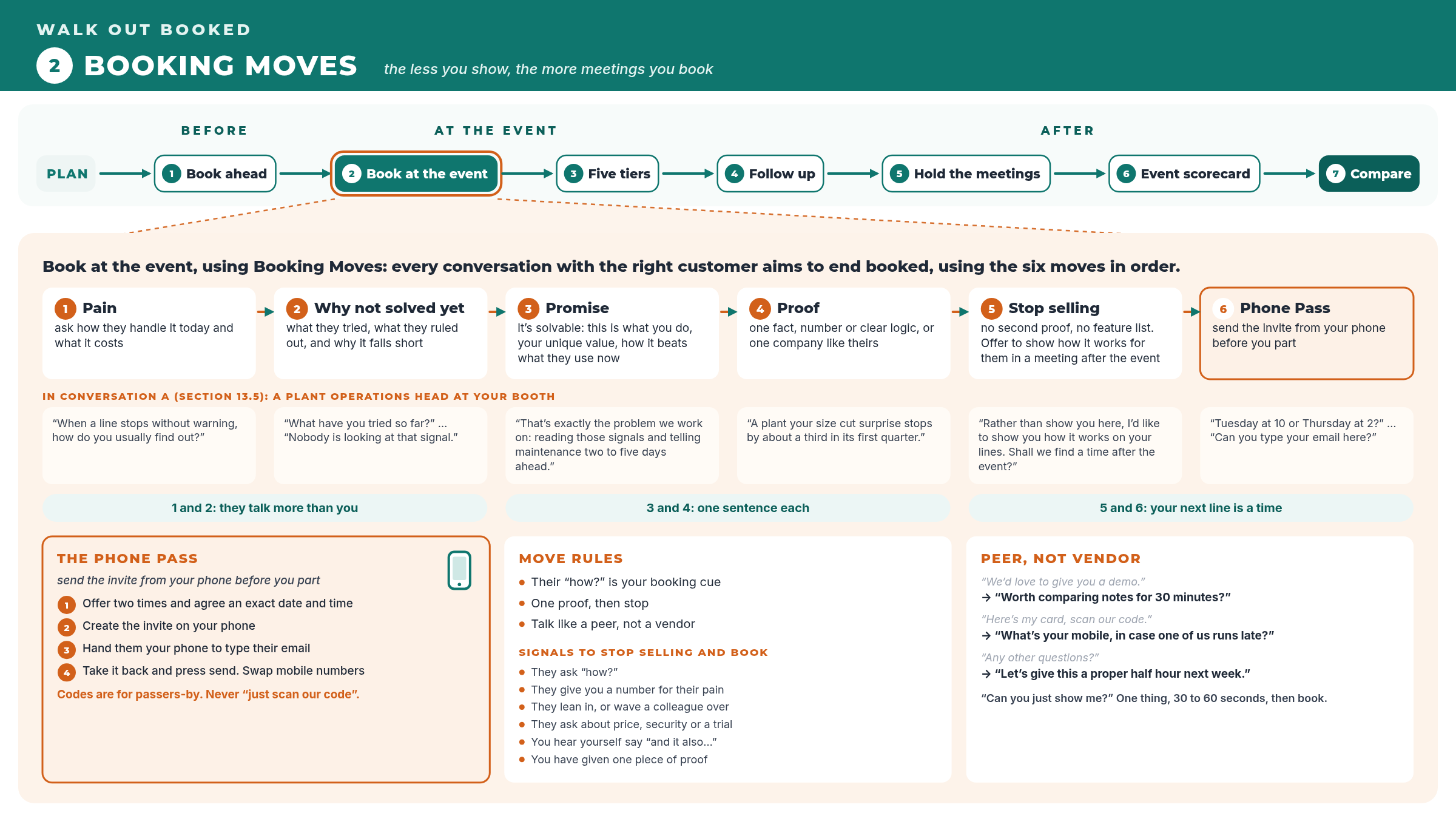
7. Step 2 · Book at the event, using Booking Moves
Step 2, zoomed in: the six Booking Moves and the Phone Pass.
Every conversation at the event has one job: put the next meeting in the calendar. The best way to get there is to talk like an expert in their problem, not like a vendor of a product. You are two professionals at a business event. Both of you know business is the reason you're there, and neither of you needs to pretend otherwise.
The meetings you booked ahead are held here too; a next meeting set in one counts as Booked at the event.
7.1 The six Booking Moves
Every conversation with the right customer aims to end booked, using the six moves in order.
1
Pain
Ask how they handle it today and what it costs: how often it happens, and what it means for them personally. Get a nod at each step.
2
Why not solved yet
Ask what they tried and what they ruled out, then show why it falls short: a cost they don't see, a risk they live with, a signal nobody watches. It is about the current way, never about them.
3
Promise
It's solvable: this is what you do, your unique value, and how it beats what they use now. One sentence: "It's solvable, and that's exactly what we work on: [what you do], [how it beats what they use now]." Say what changes; keep how it works for the meeting.
4
Proof
When you say a problem they've lived with can be solved, the next thought is often "that sounds too good to be true". Answer it with one thing only: one fact, number or clear logic, or one company like theirs.
5
Stop selling
No second proof, no feature list, no walk-through. Offer to show how it works for them in a meeting after the event.
6
Phone Pass
Offer two times and send the invite from your phone before you part (section 7.3).
The rhythm:in moves 1 and 2 they talk more than you; moves 3 and 4 are one sentence each; after moves 5 and 6 your next line is a time. Move rules: when they ask "How do you do that?", that is your booking cue. One proof, then stop. Talk like a peer, not a vendor.
7.2 The less you show, the more meetings you book
Curiosity is the gap between what someone knows and what they now want to know. Moves 2 and 3 open that gap: "what you tried falls short, and it can be solved." Move 4 makes the gap believable. The meeting is where you close it. If you close the gap at the stand, there is nothing left to meet about.
One sentence about how it works, at most. The rest belongs in the meeting, with their numbers and their setup.
End the conversation first, while they are still interested: "I've got a few more people to see. Let's give this a proper half hour."
7.3 The Phone Pass
1
Offer two times and agree an exact date and time.
2
Create the invite on your phone.
3
Hand them your phone to type their email.
4
Take it back and press send.
Swap mobile numbers while you're at it.
One way among others.
The Phone Pass is the way this guide recommends, not the only one. A giveaway handed over once the invite exists, such as the toy car, is another, and the two can be combined. Every meeting booked at the event for after it counts the same (section 2.1).
Why your phone.
On your phone the invite exists before you part, it has the right title, length and place, and the email is spelled by the one person who knows it. On their phone it becomes "I'll put it in later".
Codes are for passers-by.
The QR code or booking link on your booth sign is for people walking past when nobody is free to talk to them. Never point someone you're talking to at a code or a link: a conversation that ends with "scan our code" ends without a date.
7.4 Sounding like a peer, not a vendor
Vendor voice
Peer voice
"Let me show you how our product works."
"I've spent six years on unplanned stops in plants like yours. Can I ask how you handle them today?"
"We'd love to give you a demo."
"Worth comparing notes for 30 minutes? I'll bring what we've seen in plants your size."
"Our platform has twelve modules."
"Most of the cost sits in one place nobody measures."
"Can I walk you through it?"
"Bring last month's numbers and we'll look at them together."
"We're the leading solution for..."
"We see this in most finance teams we work with. You're not unusual."
"Here's my card, scan our code."
"What's your mobile, in case one of us runs late?"
"Any other questions?" (twenty more minutes)
"Let's give this a proper half hour next week."
7.5 Three worked conversations (made-up products)
The products are invented for illustration. Use your own words and your own real proof. The numbers in brackets mark the six Booking Moves.
Script A. A plant operations head at your booth. Product: software that warns maintenance before a machine stops.
You:      Hi, I'm Lena. I work on unplanned stops in mid-size plants. Can I ask you
          something about yours?
Visitor:  Sure.
You:      When a line stops without warning, how do you usually find out?            (1)
Visitor:  The operator calls the shift lead, then maintenance comes.
You:      And from the first sign to the fix, how long?
Visitor:  An hour. Sometimes a whole shift.
You:      How often on the older lines?
Visitor:  A couple of times a week.
You:      What have you tried so far?                                                (2)
Visitor:  Not much. We treat it as the price of old machines.
You:      Most plants do. What we keep seeing is that the machines show it days
          before, in sensor data the plant already collects. Nobody is looking at
          that signal.
Visitor:  We do have sensors. Nobody really looks at them.
You:      That's exactly the problem we work on: reading those signals and telling
          maintenance two to five days ahead, instead of after the line stops.       (3)
Visitor:  Without new hardware? Sounds too good to be true.
You:      No new hardware. It reads the sensors you have. A plant your size cut
          surprise stops by about a third in its first quarter.                     (4)
You:      Rather than show you here, I'd like to show you how it works on your
          lines. Shall we find a time after the event?                               (5)
          Is it worth a proper half hour with your own stoppage log? Tuesday at 10 or
          Thursday at 2? [they pick Thursday at 2]
          I'll put it in now. Can you type your email here? [your phone]           (6)
Script B. A finance director, met at a partner's booth. Product: software that matches invoices to orders and deliveries.
You:      I spend most of my time with finance teams on month-end. How many supplier
          invoices does your team handle in a month?                                 (1)
Visitor:  Around 4,000.
You:      And how many need someone to chase an order or a delivery note?
Visitor:  Too many. Maybe one in five.
You:      That's typical. What have you tried?                                       (2)
Visitor:  More people at month-end, mostly.
You:      The odd part is that the answer is usually already in your system, just in
          three different places. More people only search those places faster.
Visitor:  True. It's all in there somewhere.
You:      That's the problem we work on: matching invoice, order and delivery
          automatically, so people only look at the real exceptions.                 (3)
Visitor:  Everyone says that.
You:      Fair. It sits on top of the accounting system you already use. A team of six
          closed its month in two days instead of eight.                             (4)
          [stop selling]                                                             (5)
You:      Let's take a sample of your invoices and look at it together. 30 minutes
          next week: Monday at 9 or Wednesday at 3? [Phone Pass: invite sent]        (6)
Script C. A head of engineering, in the coffee queue. Product: a tool that catches breaking changes before release.
You:      Last time an interface change broke a customer's integration, how did you
          find out?                                                                  (1)
Visitor:  The customer told us. Angry ticket on a Friday.
You:      How often does that happen?
Visitor:  Every couple of months. Each one costs us a weekend.
You:      Most teams answer with more tests. The tests usually pass. The break is in
          how customers actually call you, and no test covers that.                  (2)
Visitor:  Our tests were green that time too.
You:      That's what we work on: checking every release against how customers really
          use it, before it ships.                                                   (3)
Visitor:  How would that even work?
You:      It replays a sample of real traffic against the new version, inside your
          build pipeline.                                                            (4)
          ["how?" was the cue: stop selling here]                                    (5)
You:      Is it worth half an hour on one of your own services? Thursday at 4 or
          Friday at 9? Type your email here and I'll send it now.                   (6)
7.6 Signals to stop selling and book
They ask "how?" or "how would that work for us?"
They give you a number for their pain, or say "we have exactly that problem".
They lean in, step closer, put their phone away, or wave a colleague over.
They ask about price, connecting it to their systems, security, or a trial (answers to price and competitor questions are in section 7.8).
They said "too good to be true" and you have answered once.
You hear yourself say "and it also..." or reach for the laptop.
You have given one piece of proof.
When you see any of these, your next sentence is the booking question.
7.7 "Can you just show me?"
Say yes, and show one small, specific thing for 30 to 60 seconds: the one screen, number or alert that matters for their problem. Then book.
"Sure. This is the one thing that matters: the warning maintenance would have had two days before a stop like yours. [30 seconds]
What it finds in your plant depends on how your lines run, so it's worth half an hour with your own data. Tuesday at 10 or Thursday at 2?"

If they want more: "The rest only makes sense with your numbers. That's the meeting."
7.8 When they don't say yes straight away
They say
You say or do
"I need to check with my boss."
Book a 15-minute prep call after the event to plan what their boss needs to see (template 13). It counts as Booked (section 2.1).
"I'll send an invite once I've talked to my team."
Book a 10-minute backup call after the event, just after their team talk. Cancel it if their invite arrives.
"Send me some information."
"Happy to. What would you need to see to decide whether half an hour is worth it?" Then offer the meeting again (template 14). If still no, get the mobile number.
"We're not the right company."
"Who here should I be talking to?" Ask for an introduction by name.
The person who decides is at the event too
Spend 10 minutes with your contact to understand who decides, then 2 minutes with the decider on one narrow question. Do the Phone Pass, then leave. Book the most junior person who can approve a trial.
"How much does it cost?"
Answer honestly with what drives the price, then turn back to their numbers: "It depends on [what drives it: lines, invoices, services]. For a team your size it usually lands between [range]. Whether that's worth it depends on what [problem] costs you today, and that's what the half hour is for. Tuesday at 10 or Thursday at 2?"
"We already use [competitor]."
Treat it as good news: they know the problem. "Good, then you know how much this matters. Most teams we meet use [competitor] for [what it does well]. The gap we keep seeing is [one gap]. Worth half an hour to check whether that gap is there for you?" Speak well of the competitor.
A clear no
Thank them, and connect on LinkedIn (template 24) or swap numbers.
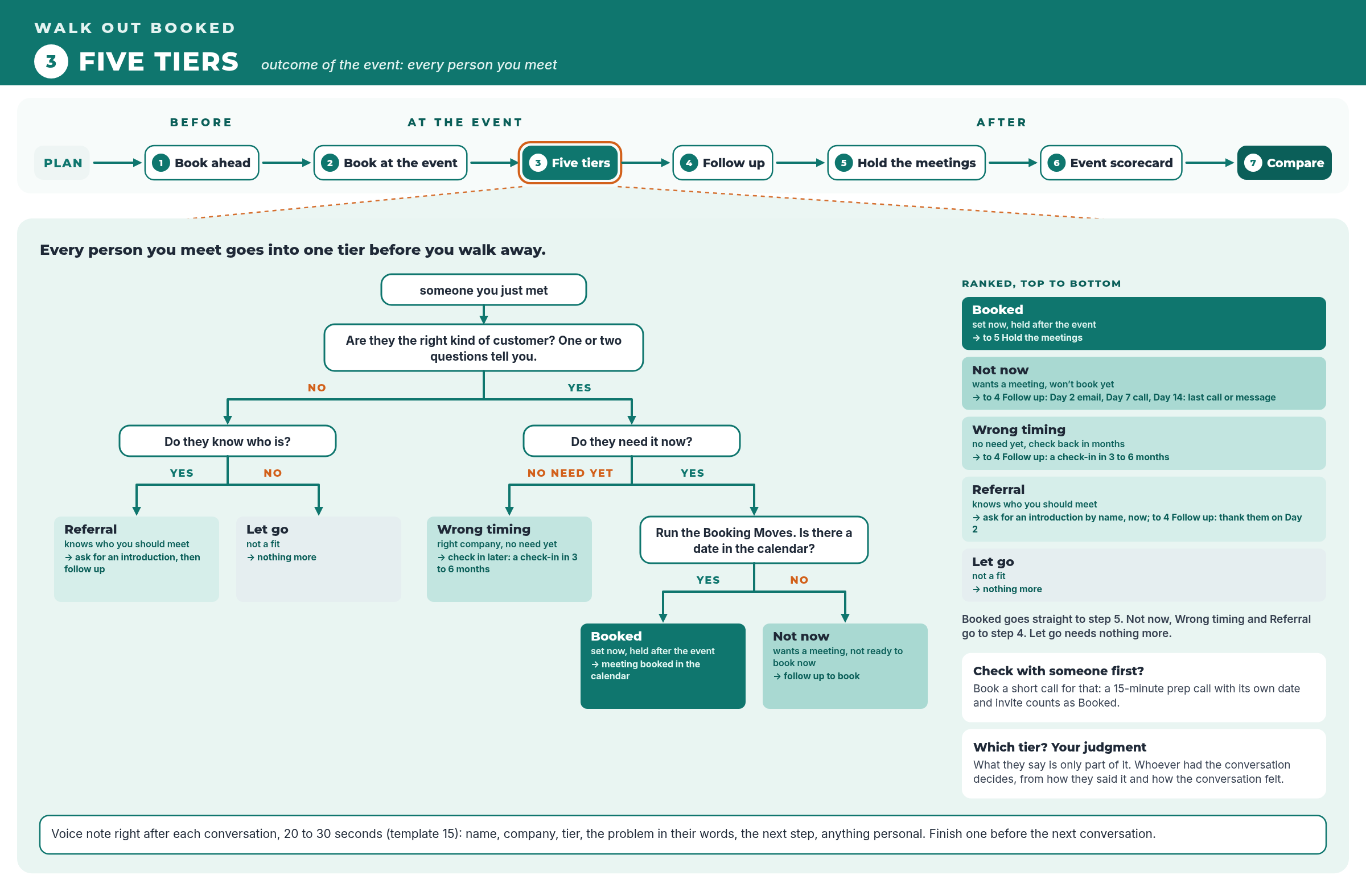
8. Step 3 · Five tiers: the outcome of the event, every person you meet
Step 3, zoomed in: every person you meet goes into one of five tiers.
Every person you meet goes into one tier before you walk away. The tiers are ranked: Booked is the top tier and gets a meeting, the next three get follow-up, and Let go gets nothing more.
Tier
Who
What comes next
Booked
set at the event, held after it (section 2.1)
the meeting, in step 5, with reminders (section 6)
Not now
wants a meeting, not ready to book now
follow up to book, in step 4. Get their mobile number
Wrong timing
right company, no need yet
check in later: a check-in in 3 to 6 months (template 25)
Referral
knows who you should meet
ask for an introduction by name, then follow up: thank the person who made it (template 23)
Let go
not a fit
nothing more
Three questions help you choose the tier
1
"Are they the right kind of customer?"
One or two questions tell you. If not: do they know who is? Yes goes into Referral, no into Let go.
2
"Do they need it now?"
No need yet goes into Wrong timing. If yes, run the Booking Moves.
3
"Is there a date in the calendar?"
Yes is Booked. They want a meeting but won't book yet: the tier Not now.
Which tier is your judgment.
What people say is only part of it. "Send me some information" can mean interested but not ready to book yet, a polite no, or maybe in a few months. How they say it, and how the conversation felt, tell you more. Whoever had the conversation decides which tier the person goes into. The point is that every person goes into one of the five tiers.
Take notes the same way every time.
Right after each conversation, record a 20 to 30 second voice note (template 15): name, company, tier, the problem in their words, the next step, anything personal. Finish one before you start the next conversation. Don't rely on a single badge-scanning app. Each evening, turn the notes into contacts and draft the emails, by hand or with an assistant.
9. Step 4 · Follow up: book those who didn't book at the event
Step 4, zoomed in: the follow-up schedule.
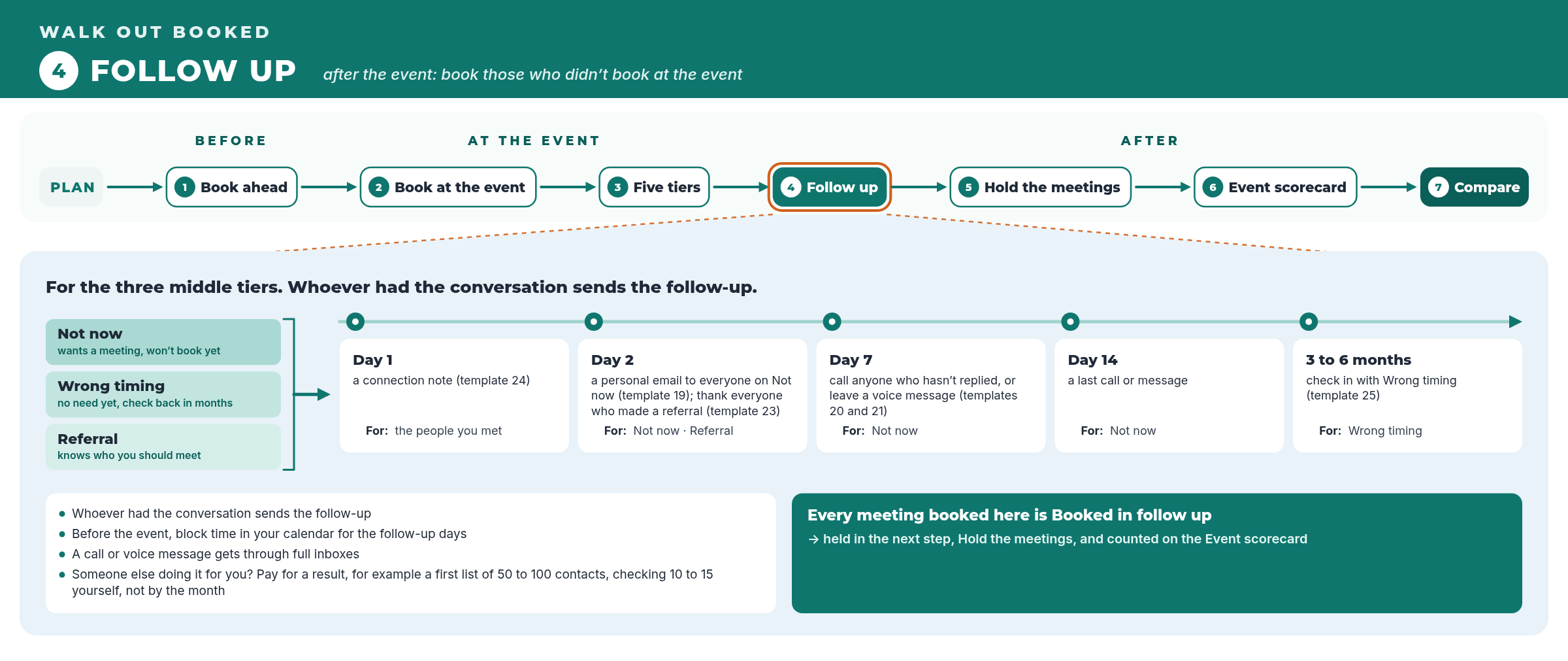
Follow up is for the three middle tiers: Not now, Wrong timing and Referral. Booked people go straight to step 5; Let go gets nothing more. Whoever had the conversation sends the follow-up.
The follow-up schedule
When
What
Tier
Day 1
a connection note (template 24)
the people you met
Day 2
a personal email to everyone on Not now (template 19); thank everyone who made a referral (template 23)
Not now, Referral
Day 7
call anyone who hasn't replied, or leave a voice message (templates 20 and 21)
Not now
Day 14
a last call or message
Not now
3 to 6 months
check in with Wrong timing (template 25)
Wrong timing
A call or voice message gets through full inboxes after an event.
Every meeting you book here is counted as Booked in follow up, and it is held in step 5.
If there is still no date after Day 14, whoever had the conversation decides which tier the person belongs in now (section 8).
10. Step 5 · Hold the meetings: the meetings booked for after the event
Step 5, zoomed in: Hold the meetings.
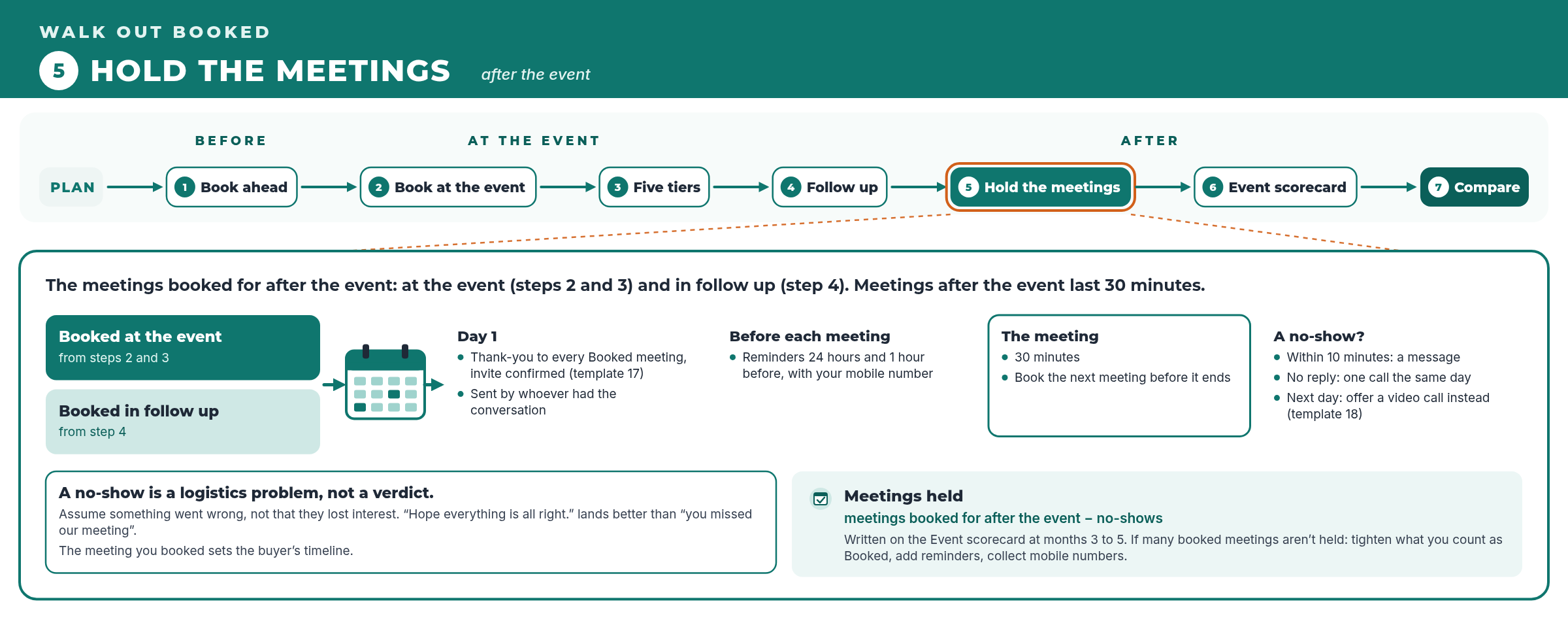
Step 5 holds the meetings booked for after the event: at the event (steps 2 and 3) and in follow up (step 4). Meeting lengths are in section 6.
When
What
Who
Day 1
thank-you to every Booked meeting, invite confirmed (template 17)
whoever had the conversation
Before each meeting
reminders, as set in section 6
the invite does it
Within 10 minutes of a no-show
a message; if no reply, one call the same day; the next day, offer a video call instead (template 18)
the person who was meant to meet them
Inside each meeting
book the next meeting before it ends
whoever runs it
Months 3 to 5
Meetings held written on the Event scorecard
the founder
A no-show is a logistics problem, not a verdict.
Assume something went wrong, not that they lost interest. "Hope everything is all right." lands better than "you missed our meeting".
The meeting you booked sets the buyer's timeline.
Book the next one inside each meeting.
Meetings held (section 2.2):
if many booked meetings aren't held, tighten what you count as Booked (section 2.1), add reminders and collect mobile numbers.
11. Step 6 · Event scorecard: one page per event
Step 6, zoomed in: the Event scorecard.
The Event scorecard is the one home for what you count: meetings, cost and return on investment. Fill in the top before you go, each number as it comes in, and the net return at the return on investment date. Its six numbers are explained in section 2.2.
11.1 The counting rules
What counts as Booked is set in section 2.1, including the 15-minute prep call for "I need to check with my boss". Anything less is not Booked.
Booked ahead stays on its own line. It is not part of Meetings held after the event, cost per meeting held or cost per booked meeting.
The return on investment date is the event's last day plus twice your typical sales cycle (first meeting to signature), at least 6 months and at most 24. A 3-month cycle gives 6 months, 6 gives 12, 12 gives 24.
Revenue means contract value signed before the return on investment date, from everyone you met at the event.
Revenue after the return on investment date goes on its own "late revenue" line. The person keeps the event's name in your records for good, so the event's lifetime total stays honest, but you compare events only up to their return on investment date.
Your team's time is a second cost line: people × days × a day rate. Show the net return with and without it.
Deals already open before the event count too, if the event booked the next meeting. Give them a mark so you can see them.
After two or three events: your own return on investment date.
Look at when your new customers stop coming in. If that point is earlier or later than twice the cycle, move your return on investment date to it.
Why twice the cycle.
Deals that close bunch around the typical cycle, with a long tail of slow ones. By about twice the typical cycle, most deals that will ever close have closed. That is late enough to be nearly complete and early enough to compare with your other events. It is a starting rule, not an industry standard.
11.2 The Event scorecard: one copy per event
Event details (before you go)
Event name and dates
Your setup: with a booth / without a booth (full conference pass or show floor pass only)
Opener, Booker, Scout: who is who
Main customer group
Second and third customer groups
Other goals (investors, hiring, press), each with an owner
Typical sales cycle in months (first meeting to signature)
Return on investment date (section 11.1, counting rule 3)
Costs
Tickets
Booth and build
Travel
Hotel
Helpers
Giveaways and print
Tactics
Other
Total event cost
Team time: people × days × day rate (second cost line)
The six numbers (one column per customer group)
Number
When
Booked ahead
the day before the event
Booked at the event
as you leave the event
Booked in follow up
after the follow-up days
Meetings held
months 3 to 5
Cost per meeting held
months 3 to 5
Return on investment (revenue minus event cost)
return on investment date
Supporting rows (one column per customer group)
Row
When
Invites sent
the day before the event
Booked ahead that took place
as you leave the event
People in Not now
as you leave the event
Cost per booked meeting so far
as you leave the event
Share of Booked meetings that were held
months 3 to 5
New customers
return on investment date
Revenue signed before the return on investment date
return on investment date
of which, deals already open before the event
return on investment date
Net return after team time
return on investment date
Revenue after the return on investment date ("late revenue")
later
By person (columns)
Person
Role
Conversations
Booked meetings
People in Not now
Referrals
Tactics and giveaways (columns)
Tactic
Subtle or loud
Cost
How many used
Booked meetings or referrals it brought
Cost per meeting from this tactic
Notes (when, what you saw, one change for next time)
As you leave the event
Debrief, about day 10
Months 3 to 5
Return on investment date
The Debrief, about day 10, goes through the numbers so far and writes one change on the scorecard (template 22).
Template · The blank Event scorecard to copy
EVENT SCORECARD (one copy per event)

Event details (before you go)
| Field | Your entry |
|---|---|
| Event name and dates | |
| Your setup: with a booth / without a booth (full conference pass or show floor pass only) | |
| Opener, Booker, Scout: who is who | |
| Main customer group | |
| Second and third customer groups | |
| Other goals (investors, hiring, press), each with an owner | |
| Typical sales cycle in months (first meeting to signature) | |
| Return on investment date (section 11.1, counting rule 3) | |

Costs
| Cost | Amount |
|---|---|
| Tickets | |
| Booth and build | |
| Travel | |
| Hotel | |
| Helpers | |
| Giveaways and print | |
| Tactics | |
| Other | |
| Total event cost | |
| Team time: people × days × day rate (second cost line) | |

The six numbers (one column per customer group)
| | When | Main group | Second group | Third group | Total |
|---|---|---|---|---|---|
| Booked ahead | the day before | | | | |
| Booked at the event | as you leave | | | | |
| Booked in follow up | after the follow-up days | | | | |
| Meetings held | months 3 to 5 | | | | |
| Cost per meeting held | months 3 to 5 | | | | |
| Return on investment (revenue minus event cost) | return on investment date | | | | |

Supporting rows
| | When | Main group | Second group | Third group | Total |
|---|---|---|---|---|---|
| Invites sent | the day before | | | | |
| Booked ahead that took place | as you leave | | | | |
| People in Not now | as you leave | | | | |
| Cost per booked meeting so far | as you leave | | | | |
| Share of Booked meetings that were held | months 3 to 5 | | | | |
| New customers | return on investment date | | | | |
| Revenue signed before the return on investment date | return on investment date | | | | |
| of which, deals already open before the event | return on investment date | | | | |
| Net return after team time | return on investment date | | | | |
| Revenue after the return on investment date ("late revenue") | later | | | | |

By person
| Person | Role | Conversations | Booked meetings | People in Not now | Referrals |
|---|---|---|---|---|---|
| | | | | | |

Tactics and giveaways
| Tactic | Subtle or loud | Cost | How many used | Booked meetings or referrals it brought | Cost per meeting from this tactic |
|---|---|---|---|---|---|
| | | | | | |

Notes
| When | What you saw | One change for next time |
|---|---|---|
| As you leave | | |
| Debrief, about day 10 | | |
| Months 3 to 5 | | |
| Return on investment date | | |
12. Step 7 · Compare: each number against the same number at your other events
Step 7, zoomed in: Compare.
Which numbers lead: booked meetings in the short term, the net return in the long term (section 2.2).
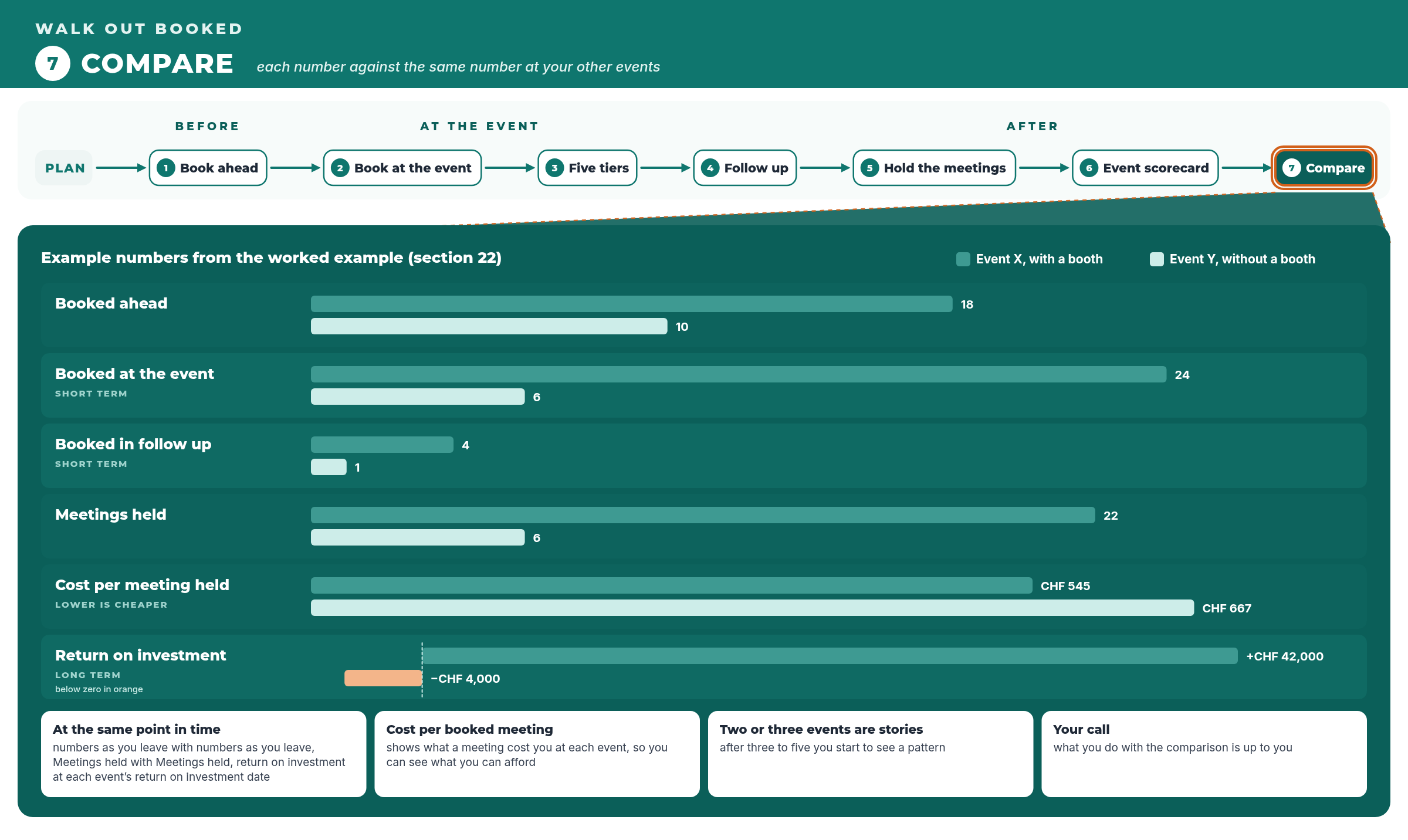
Compare each number with the same number, at the same point in time: numbers as you leave with numbers as you leave, Meetings held with Meetings held, the net return at each event's return on investment date.
Cost per booked meeting shows what a meeting cost you at each event, so you can see what you can afford.
Two or three events are stories. After three to five you start to see a pattern.
What you do with the comparison is your call.
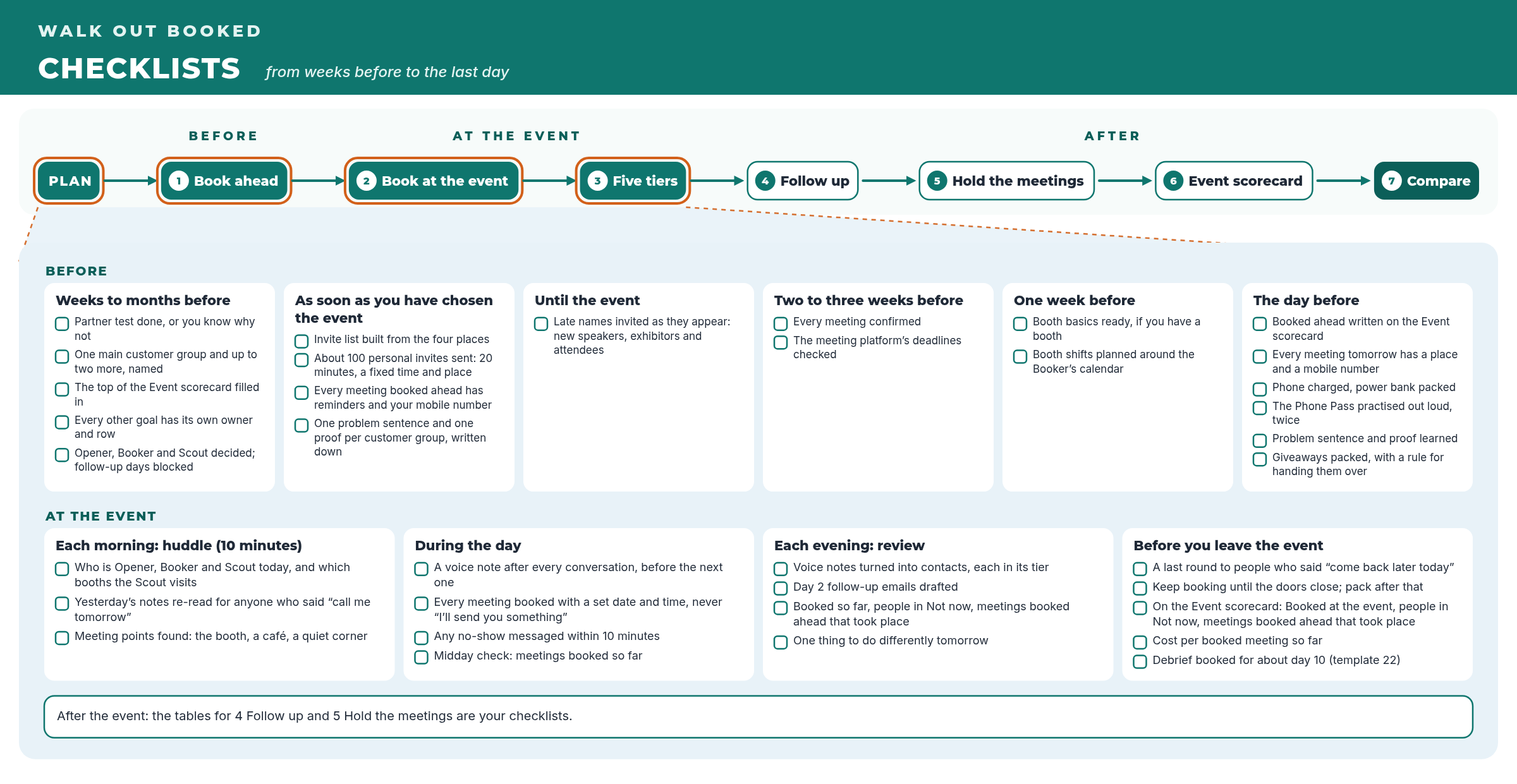
13. Checklists, from weeks before to the last day
The checklists, from weeks before to the last day.
These checklists are the working version of sections 3 to 8. Tick them off as you go.
Checklist · Weeks to months before
Partner test done: a partner booked you three meetings, or you know why not (section 3)
One main customer group and up to two more, named
The top of the Event scorecard filled in (section 11)
Every other goal (investors, hiring, press) has its own owner and row
Opener, Booker and Scout decided (section 4), and follow-up days blocked in the calendar
Checklist · As soon as you have chosen the event
Invite list built from the four places in section 6
At least 100 personal invites sent, each offering 20 minutes at a fixed time and place (templates 1 to 8)
Every meeting booked ahead has an invite with reminders and your mobile number (section 6)
One problem sentence and one proof per customer group, written down
Checklist · Until the event, and two to three weeks before
Late names invited as they appear: new speakers, exhibitors and attendees
Every meeting confirmed (two to three weeks before)
The deadlines of the event's meeting platform checked (two to three weeks before)
Checklist · One week before
Booth basics ready, if you have a booth (section 3.2)
Booth shifts planned around the Booker's calendar
Checklist · The day before
Booked ahead written on the Event scorecard
Every meeting tomorrow has a place and a mobile number
Phone charged, power bank packed, calendar one tap away for the Phone Pass
The Phone Pass practised out loud, twice
One problem sentence and one proof per customer group, learned
Giveaways packed (if any), and a clear rule for when you hand them over
Checklist · Each morning: huddle (10 minutes)
Who is Opener, Booker and Scout today, and which booths the Scout visits
Yesterday's notes re-read for anyone who said "call me tomorrow"
Meeting points found: the booth, a café, a quiet corner
Checklist · During the day
A voice note after every conversation, before the next one
Every meeting booked with a set date and time, never "I'll send you something"
Any no-show messaged within 10 minutes
Midday check: meetings booked so far
Checklist · Each evening: review
Voice notes turned into contacts, each in its tier
Day 2 follow-up emails drafted
Booked so far, people in Not now, meetings booked ahead that took place
One thing to do differently tomorrow
Checklist · Before you leave the event
A last round to people who said "come back later today"
Keep booking until the doors close; pack after that
On the Event scorecard: Booked at the event, people in Not now, meetings booked ahead that took place
Cost per booked meeting so far written on the Event scorecard
Debrief booked for about day 10 (template 22)
After the event: the tables in sections 9 and 10 are your checklists.
14. Scripts and templates
How to use the templates.Replace the parts in [brackets]. Keep every claim true and every message short. Write as an expert in the problem talking to a peer: you work on this problem every day, you know this is a business event, and you don't need to pitch. Meeting lengths follow section 6.
Before the event (step 1, Book ahead)
Template 1 · Email to a company you expect at the event
Subject: [problem in their words] at [event]?

Hi [first name],

I've spent the last [years] working on [problem] with [their role]s at companies like [their company type]. One pattern keeps coming up: [one surprising observation].

I'll be at [event] on [dates]. If you're going too, I'd value 20 minutes to compare notes: how you handle it at [their company], and what we've seen elsewhere.

[Day] at [time] at [place: stand B42 / the café in hall 3]? If another slot is easier, tell me and I'll send an invite.

[Name], co-founder, [company] · [mobile]
Template 2 · Expert to expert
Subject: How [their role]s handle [problem]

Hi [first name],

I lead [your area] at [company], and over the past [months] I've compared how [number] [their company type]s handle [problem]. The gap between [what most teams assume] and [what actually happens] surprised me.

You'll be at [event]. Would you be up for 20 minutes over coffee on [day] at [time]? I'm curious how you look at it at [their company], and happy to share what we found.

[Name] · [mobile]
The same role on both sides, for example a head of engineering writing to a head of engineering, or a chief marketing officer to a chief marketing officer.
Template 3 · To a sponsor or exhibitor who is your kind of customer
Subject: Your stand at [event]

Hi [first name],

I saw [company] is exhibiting at [event]. I'll be there too. Much of my work is on [problem] for teams like yours, and I suspect your own team deals with it.

Stand days are busy, so: could I come by at a quiet moment, say [day] at [time], for 20 minutes? Pick another slot if that's better.

[Name] · [mobile]
Template 4 · To an exhibitor whose clients are your kind of customer (a possible partner)
Subject: Your clients at [event]

Hi [first name],

Your clients are [their clients' role]s, and so are ours. We work on [problem], which sits next to what you do for them, not against it.

Two ideas for [event]: a 20-minute coffee on [day] to see whether there's a fit, and if there is, short introductions to each other's one or two clients who are coming.

[Name] · [mobile]
Template 5 · Asking a partner or friendly customer for introductions (the partner test)
Hi [first name], we're going to [event]. Would you be up for booking 20-minute meetings there between us and three of your contacts who deal with [problem]? I'll handle the invites. If none of them are going, that tells me something useful too.
Template 6 · The meeting invite
Title:     [Their company] and [your company]: [the problem in four words]
Where:     [stand B42 / café in hall 3 / video link]
What:      [20 or 30] minutes on how [their company] handles [problem] today, and what we've seen work elsewhere.
Mobile:    [your mobile]. Running late or can't find it? Text me.
Reminders: 24 hours and 1 hour before.
Length as in section 6.
Template 7 · Inviting someone to a side breakfast you host
Subject: Breakfast for [number] [their role]s at [event], [day]

Hi [first name],

On [day] at [time], before the doors open, I'm hosting a breakfast for [number] [their role]s at [place next to the venue]. One topic: [problem in their words]. No slides; everyone brings one example from their own company.

Would you join? I'll send an invite with the address and my mobile.

[Name] · [mobile]
Template 8 · Asking a speaker for 10 minutes
Subject: Your talk at [event]

Hi [first name],

I'll be at your talk on [topic] on [day]. I work on [problem] with [their role]s, and your point on [something from the talk description or a past talk] matches what we see.

Could I have 10 minutes right after your session, or [day] at [time] at [place]? I'd value your view on [one specific question].

[Name] · [mobile]
At the event (steps 2 and 3)
Template 9 · Opening at your booth (Opener)
"Hi, I'm [name]. I work on [problem] with [their role]s. Can I ask you something about how you handle it?"

If they ask what you do first: "Short version? We help [role]s stop [problem]. Most teams think it's normal. How do you handle it today?"
Template 10 · Opening at another company's booth (Scout)
To their staff, when the booth is quiet:
"Hi, I'm [name] from [company]. I'm not here to talk to your visitors. I think we work with the same people: [role]. Who on your team looks after [problem]? Could we find half an hour with them after the event?"

If they are your kind of customer: "Quick question: how does your team handle [problem]?"

Leave within five minutes with a time, a referral or a name.
Template 11 · The booking question (after the one proof, then stop selling)
"Is it worth a proper half hour with your own [numbers / setup]?
[Day] at [time] or [day] at [time]?"

[The Phone Pass (section 7.3). Then: "What's your mobile?"]
Template 12 · Inside a meeting at the event, 10 minutes before the end
"We've got ten minutes left. From what you've said, the useful next step is [one specific thing with their data / their team]. Shall we put that in for [day] at [time]?"
Template 13 · "I need to check with my boss"
"Makes sense. Let's make it easy: 15 minutes on [day] at [time], just the two of us, to plan what your boss would want to see. Then we set up the real meeting together, or at least then I can give you a customised document for your boss."
Template 14 · "Send me some information"
"Happy to. What would you need to see to decide whether half an hour is worth it?"
[answer]
"That's exactly what we'd cover. [Day] at [time] or [day] at [time]?"

If still no: "Fine. What's the best mobile to reach you next week?"
Template 15 · Your own voice note after each conversation
"[Name], [role], [company]. Tier: [Booked / Not now / Wrong timing / Referral / Let go].
Problem in their words: [...].
The proof that landed: [...].
Next step: [date or action]. Personal: [family, hobby, where they're from].
Met by: [me / Opener / Scout]."
Template 16 · Giveaway lines
To book now:     "If you book our next call right now, you can take this one."
For a referral:  "If you introduce me to someone here who should hear this, this one's for your kid."

Hand it over only once the invite exists or the introduction is made.
After the event (steps 4, 5 and 6)
Template 17 · Day 1: thank-you and confirmation (Hold the meetings)
Subject: [day] at [time]

Hi [first name], good to meet you at [event]. You mentioned [their words about the problem]. Our call on [date] at [time] stands. I'll bring [the one thing they asked about].
[Name] · [mobile]
Template 18 · When someone doesn't show up (Hold the meetings)
Within 10 minutes, text: "Hi [first name], I'm at [place]. Hope everything is all right. Shall we find another time next week?"

Same day, if no reply: call once and leave a short voice message.

Next day: "Shall we do half an hour by video on [day] at [time] instead? I'll send the invite."
Template 19 · Day 2: follow-up email to everyone on Not now
Subject: [their problem in their words]

Hi [first name],

At [event] you mentioned [their words]. It's one of the patterns we see most often, and the teams that fixed it usually started by [one concrete first step].

The useful version of this conversation needs your own [numbers / setup]. Half an hour on [day] at [time] or [day] at [time]? Or pick a slot: [link].

[Name] · [mobile]
Template 20 · Day 7: follow-up call
"Hi [first name], it's [name] from [company]. We talked at [event], at [where you met], about [problem]. Is now a bad time?"

[if not] "You said [their words]. I said I'd come back with [the first step]. It needs half an hour with your [numbers]. Would [day] at [time] work?"

If they're busy: "When's better, tomorrow morning or Thursday?"
Template 21 · Voice message, when they don't pick up
"Hi [first name], [name] from [company]. We met at [event] about [problem]. I have one thought on [their words]; it takes half an hour. I'll text you two times. Talk soon."

Keep it to 20 to 30 seconds, then send the text.
Template 22 · Debrief, about day 10, 45 minutes (Event scorecard)
1. Numbers (10 minutes): invites sent; Booked ahead and how many took place; Booked at the event; people in Not now; cost per booked meeting so far.
2. What brought Booked meetings (10 minutes): which opening, which proof, which meeting point.
3. Where meetings slipped away (10 minutes): long talks, missed signals to stop selling, no-shows.
4. Tactics (5 minutes): what each giveaway or stunt brought, in meetings, at what cost.
5. One change for the next event (5 minutes): just one, written on the Event scorecard.
6. Follow-up check (5 minutes): who still owes whom a call, and by when.
Template 23 · Thanking someone who made a referral
Hi [first name], thank you for introducing me to [name] at [event]. We've booked [day] to look at [problem] together. I'll let you know how it goes. If there's anyone I can introduce you to, tell me.
[Name]
Template 24 · LinkedIn connection note
"Good to meet you at [event], [first name]. You mentioned [their words about the problem]. Looking forward to [day] / Glad to stay in touch on [problem]. [Name]"
Keep it under 300 characters.
Template 25 · Check-in after 3 to 6 months (Wrong timing)
Subject: [their problem in their words], [months] on

Hi [first name],

We met at [event] in [month]. Back then [problem] wasn't a priority for you. Since then we've seen [one new observation, or a result at a company like theirs].

If it's on the table now, half an hour on [day] at [time]? If not, no reply needed. I'll check back after [next event / next quarter].

[Name] · [mobile]
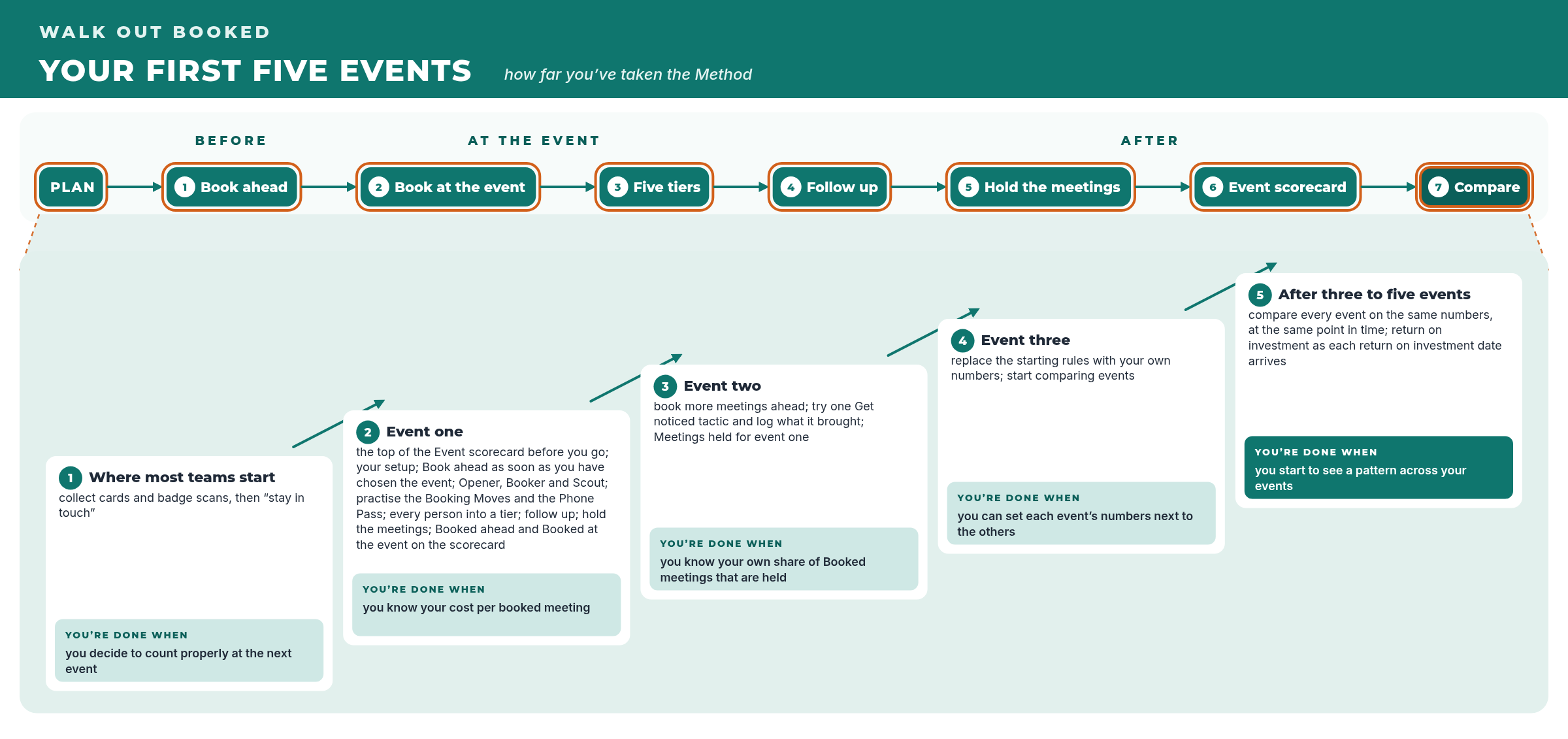
15. Your first five events
Your first five events: how far you've taken the method.
This is about your company, not about one event: how far you've taken the Method.
Step
What you do
You're done when
1. Where most teams start
collect cards and badge scans, then "stay in touch"
you decide to count properly at the next event
2. Event one
Fill in the top of the Event scorecard before you go. Choose your setup. Book ahead as soon as you have chosen the event, set Opener, Booker and Scout, practise the Booking Moves and the Phone Pass, put every person into a tier, follow up, hold the meetings. Write Booked ahead and Booked at the event on the scorecard
you know your cost per booked meeting
3. Event two
Book more meetings ahead. Try one Get noticed tactic and log what it brought. Write Meetings held for event one
you know your own share of Booked meetings that are held
4. Event three
Replace the starting rules with your own numbers. Start comparing events (section 12)
you can set each event's numbers next to the others
5. After three to five events
Compare every event on the same numbers, at the same point in time. Work out the net return as each return on investment date arrives
you start to see a pattern across your events
16. Worked example (illustrative numbers)
A two-person Swiss software startup. Main customer group: heads of plant operations at mid-size manufacturers. Second group: the system integrators who serve them. Typical sales cycle 6 months, so the return on investment date is 12 months after the event.
Event X: a two-day trade show, with a booth (the founder as Booker, the second person as Scout, a paid Opener)
Costs
Cost
Amount
Booth
CHF 5,500
Tickets
CHF 700
Travel
CHF 1,400
Hotel
CHF 1,800
Booth helper
CHF 2,000
40 toy cars, about CHF 8 each
about CHF 320
Print
CHF 280
Total event cost
CHF 12,000
Team time: 2 people × 3 days (including setup day) × CHF 800
CHF 4,800
Results
Number
Result
Booked ahead
120 invites sent (about 100 when the event was chosen, 20 to late names); 18 meetings booked ahead; 15 of them took place
Booked at the event
24; 30 people in Not now. Cost per booked meeting as you leave: CHF 12,000 ÷ 24 = CHF 500
Booked in follow up
4, all from the 30 people in Not now
Meetings held, month 4
22: 18 of the 24 Booked at the event (75%), and the 4 Booked in follow up
Cost per meeting held
CHF 12,000 ÷ 22 ≈ CHF 545
Net return, month 12
3 customers, CHF 54,000. CHF 54,000 − CHF 12,000 = +CHF 42,000 (+CHF 37,200 after team time). Marked: CHF 18,000 came from a deal already open before the event
Month 20
one more customer, CHF 24,000, on the late-revenue line. Lifetime total CHF 78,000
Event Y: a conference, without a booth (full conference pass)
Number
Result
Cost
CHF 4,000
Booked ahead
10 meetings booked ahead; 8 of them took place
Booked at the event
6; 12 people in Not now. Cost per booked meeting as you leave: CHF 4,000 ÷ 6 ≈ CHF 667
Booked in follow up
1
Meetings held, month 4
6: 5 of the 6 Booked at the event (83%), and the 1 Booked in follow up
Cost per meeting held
CHF 4,000 ÷ 6 ≈ CHF 667
Net return, month 12
no customers: −CHF 4,000
Reading it.Event Y was cheaper, but it booked fewer meetings, each meeting held cost more, and nothing closed before the return on investment date. Short term, Event X booked 28 meetings for after the event against Event Y's 7. Long term, Event X returned +CHF 42,000 and Event Y −CHF 4,000. What you do next is your call. If you go back to Event Y, the levers are twice as many meetings booked ahead, or a Scout with a list of exhibitors who are your customers.
17. When it goes wrong
What goes wrong
Early sign
What to do
A "maybe" counted as Booked
many Booked meetings, few held
only a set date and time in the calendar counts (section 2.1)
Trends read from tiny numbers
one event changes your plan
compare after three to five events
Back to business cards because booking feels pushy
Not now grows, Booked shrinks
practise the Phone Pass out loud before the event
The conversation runs past Stop selling
long conversations, few meetings
one proof, then two times; look at it in the evening review
A booking link instead of an invite sent before you part
"I'll book later", empty calendar
book before you part; codes are for passers-by (section 7.3)
The founder stuck at the booth
meetings booked ahead missed
an Opener who brings good fits to the Booker (section 4), or the passers-by sign
No follow-up time planned
day 7 calls slip to day 30
block the follow-up days before the event
A tactic gets attention but no meetings
photos, no bookings
point it at one chance to book (section 5.2)
Revenue judged too early
"the event didn't work" at month 3
look at booked meetings early, and at the net return only at the return on investment date
Other goals take over
investor meetings fill the calendar
each goal its own row and owner
Reference
Making it smaller or bigger
Smallest version (a founder alone at a first event)
Part One, the Booking Moves and the Phone Pass (sections 7.1 and 7.3), templates 9, 11, 18 and 19, and the six numbers table of the Event scorecard.
Bigger team
One Event scorecard per event, a column per customer group, a row per person, and one person who merges notes every evening.
Long sales cycles (over 12 months)
The return on investment date stops at 24 months. Use Meetings held as your guide until then, and don't judge revenue before the return on investment date.
Many events a year
Keep the comparison (section 12) on one page and look at it every quarter.
The rules
A date, not a card.
"Drop by any time" is not a meeting.
Your phone, their email. That is the Phone Pass.
Codes are for passers-by (section 7.3).
One proof, then stop.
When they ask "How do you do that?", that is your booking cue.
Talk like a peer, not a vendor.
Don't work the room. Book it.
Badge scans don't count. Neither do booth visitors or likes.
Book the next meeting inside this one.
A no-show is a logistics problem, not a verdict (section 10).
Count booked meetings as you leave; work out the net return at the return on investment date.
Every tactic leads to a chance to book.
Every goal gets an owner, or the customers lose.
Keep booking until the doors close. Pack after that (section 3.2).
Rules 5, 6 and 7 are the move rules on the Booking Moves card.
Glossary: more words
Word
Meaning
Before
from choosing the event until the event starts
At the event
the event days
After
from the event's last day on
With a booth
you rent a stand: a showroom that makes passers-by stop at a glance, and your meeting point
Without a booth
you come with a pass and go to the people, with one meeting point at the event that anyone you book can easily find
Opener
starts talks: at the edge of your booth, opens conversations, brings good fits to the Booker
Booker
books: usually the founder; holds the calendar, runs the meetings; whoever books does the Phone Pass
Scout
explores: visits other booths and the hallways for introductions and meetings, and books them too
Morning huddle
10 minutes each morning: who does what, which booths the Scout visits
Evening review
each evening: who is Booked, who is in Not now
Debrief
about day 10: what brought Booked meetings, one change
Walk Out Booked
this method: an event is worth the meetings it books you: before, during and after
Typical sales cycle
the middle value of the time from first meeting to signature across your recent deals
Customer group
a kind of buyer you sell to, such as heads of plant operations at mid-size manufacturers
Partner test
asking a partner or friendly customer to book three meetings at the event with their own contacts, to check your customers will be there
Invite list
the people you invite before the event: first invites as soon as you have chosen the event, late names as they appear
Meeting point
the one place at the event where your meetings happen: your stand, or a spot anyone you book can easily find
Late revenue
revenue from event contacts after the return on investment date; counted in the lifetime total, not in comparisons
Subtle tactic
a quiet way to be seen; works even if everyone knows how it works
Loud tactic
bold, playful or unexpected; works because nobody expects it